

Soft Skills more necessary than ever according to new report
In a world where AI and machine learning is a top desired skill for businesses globally, are we neglecting the human element?

With the rise of AI and integration into daily business tasks, are companies prioritising quick automation over the most important human soft skills? There’s no denying AI has and is completely changing the way we work and live, from using ChatGPT to create meal plans to the use of AI in healthcare automation.
It was recently revealed in the 2025 AI at Work Report that 74% of executives see AI as critical to their company’s success with 60% already ‘aggressively’ using AI to innovate. But with such a focus on automating and decision-making being left to AI – where does that leave core human centric soft skills.
Copy-edited by
Tabatha Cook is a dedicated Careers Services Manager at Learning People, bringing a wealth of recruitment experience, having helped hundreds of professionals into their dream careers.

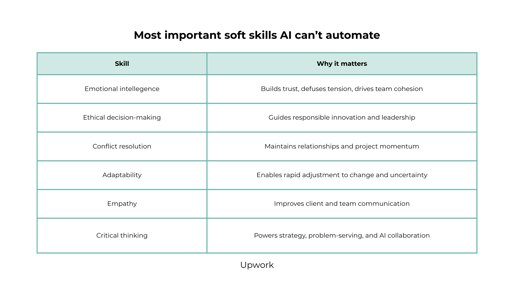
According to World Economic Forum, 7 out of the top 8 core desired skills for workers globally were soft skills including: resilience, flexibility and agility, leadership and social influence, motivation and self-awareness, empathy and active listening. Soft skills like these are difficult to automate and provide nuances to prompts and requests.
In the age of AI, workers must utilise creativity, adaptability, clear communication, and critical thinking to stay competitive. Responsible AI skills are essential, including AI ethics, spotting bias and understanding its impact on outcomes.
The report says, “workers must balance hard and soft skills to thrive in today’s work environments.”
Soft skills are no longer optional, they’re essential for career growth, resilience, and long-term success in today’s unpredictable job market. Professionals who master empathy, adaptability, and creativity are driving innovation, shaping the future of work, and standing out to employers.
The Human to AI connection
A survey by Upwork revealed that 90% of workers view AI as a coworker with 67% of top AI performers trusting AI more than their teammates with 64% expressing they have a better relationship with AI than their human colleagues.
The survey interestingly revealed more insights into the human – ai connection, like how 85% of people who use AI frequently reporting they are more polite to AI than their co-workers and that 79% found AI was more polite to them.
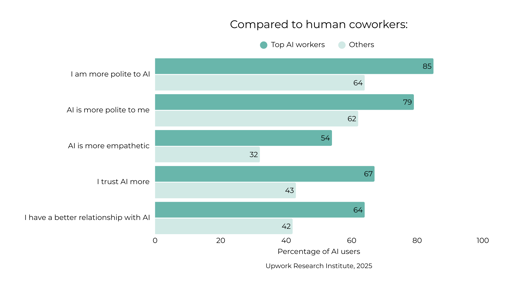
These figures indicate a clear divide between human-to-human interaction which highlights a gap in basic human soft skills. How can this be rectified and how can soft skills create better use of AI?
Building on interpersonal skills for optimum output from humans and AI
Not only are soft skills essential for success in your career, but they are also crucial to correct use and implement AI within the workforce. In tech, soft skills are fundamental for team-based environments.
From communication and empathy to creativity and time management, soft skills cover a variety of areas, and our Business Skills Pathway will equip you with everything you need for a successful career.
The course covers topics such as influence and persuasion, presentation skills, critical thinking, risk management and more which you can continue to develop throughout your career.
Investing in professional development now ensures you’re ready to thrive in a rapidly changing world of work. Why not arrange a free call with one of our expert career consultants to discuss your future today.
Related Articles
 Cyber Security
Understanding the different types of cyber security threats – December 2025
Discover the types of cyber security threats and how professionals tackle challenges like ransomware, phishing, and insider threats. Explore the risks posed by DDoS attacks and IoT vulnerabilities, and learn how Learning People’s expert-led cyber security courses prepare you for a future-proof career.
Read More Cyber Security
Australia’s Cyber Security workforce faces sustained demand, according to latest Government reports
The Australian Government’s most-recent Labour Market for Migrants report reveals that employment in the Cyber Security sector is set to grow by 14.2% by 2029.
Read More Career Advice
The Uses and Impact of AI in Data Analytics
Discover how artificial intelligence is driving and transforming data analytics, from uncovering deeper insights to driving smarter business decisions. Learn about the key uses, benefits, and real-world impact of AI in analytics, and explore how these innovations are shaping the future of data-driven industries.
Read More Cyber Security
Our Cyber Security student success stories
We've helped thousands of students start new and rewarding careers in Cyber Security. Explore their stories to get excited about starting your own career in the growing sector.
Read More